Key Takeaways
- Roth conversions can offer tax flexibility but require careful assessment of timing, income, and retirement goals.
- It’s vital to consider the impact on Social Security, Medicare, and long-term planning when evaluating conversions.
With more retirees focusing on long-term financial strategies, Roth conversions are increasingly part of the conversation. By understanding the nuances of the process, you can better decide whether incorporating a Roth conversion into your retirement plan fits your needs and goals.
What Is a Roth Conversion?
Defining Roth conversion basics
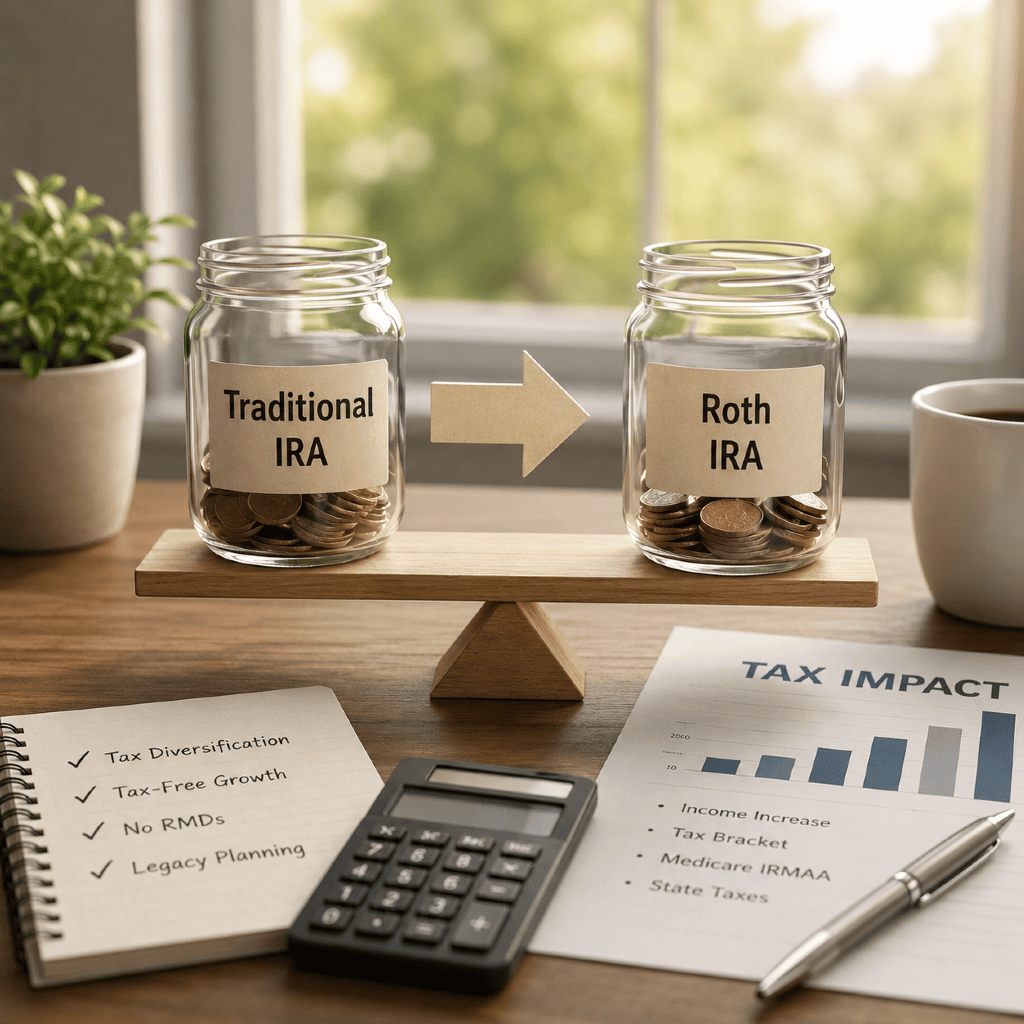
A Roth conversion involves moving funds from a pre-tax retirement account, such as a traditional IRA or 401(k), into a Roth IRA. The key distinction is that traditional IRAs are funded with pre-tax dollars, meaning taxes are deferred until you withdraw funds. In contrast, Roth IRAs are funded with after-tax dollars, so qualified withdrawals are generally tax-free in retirement.
A conversion transforms some or all of your pre-tax savings into after-tax assets. This process requires you to pay ordinary income taxes on the converted amount in the year of the switch. The appeal is the prospect of tax-free growth and withdrawals once the assets are held in the Roth IRA.
How the process works
To complete a Roth conversion, you instruct your financial institution to transfer the desired amount from your traditional IRA or eligible employer plan into your Roth IRA. The process can be executed as a direct transfer or a 60-day rollover, though direct transfers are often encouraged for clarity and administrative ease. As soon as the conversion is processed, your converted amount is taxed as ordinary income for the year of the move.
Why Consider Roth Conversions in Retirement?
Potential benefits for retirees
Many retirees find Roth conversions attractive for several reasons. First, Roth IRAs do not have required minimum distributions (RMDs), while traditional IRAs do. This allows you greater control over your withdrawal strategy and the ability to potentially leave more assets growing tax-free. In addition, withdrawing from a Roth IRA in retirement can provide income without increasing your taxable income, potentially lowering the tax burden on other sources of retirement income.
Common motivations and concerns
Choosing to convert in retirement often hinges on anticipated tax rates, the desire for flexible withdrawal strategies, and the aim to lessen future tax liability for heirs. Some retirees are motivated by the chance to diversify tax treatment among their accounts. However, there are concerns, notably the tax bill generated by the conversion and how it might affect overall cash flow in retirement. Deciding if, how much, and when to convert requires a careful look at your short- and long-term financial plans.
How Do Roth Conversions Affect Taxes?
Taxable income changes
When you convert funds to a Roth IRA, the entire converted amount is added to your taxable income for that year. This additional income could push you into a higher tax bracket, resulting in a larger tax bill. For example, if you are already close to the next marginal tax bracket, even a modest conversion could have a noticeable impact. Planning incremental or partial conversions across multiple years is one way you might help smooth out the resulting tax effects.
Implications for Social Security and Medicare
Roth conversions may also impact other elements of your retirement income, such as Social Security and Medicare. When your taxable income increases due to a conversion, a greater portion of your Social Security benefits may become subject to income tax. Additionally, higher income could trigger increased Medicare Part B and Part D premiums, known as Income-Related Monthly Adjustment Amounts (IRMAA). It’s important to account for these ripple effects when timing a conversion.
What Key Factors Should You Weigh?
Time horizon and retirement goals
Your time horizon—the number of years you plan to let converted assets grow—can significantly influence the value of a Roth conversion. Generally, the longer funds remain in a Roth IRA, the more time they have to grow tax-free, enhancing the potential benefit. Consider your personal timeline for withdrawals and your overall retirement income needs when evaluating if a conversion suits your situation.
Sequence of withdrawals
Strategically sequencing withdrawals is vital. Some retirees find it effective to use pre-tax funds in the early years of retirement, deferring Roth withdrawals until later. Alternatively, others prefer converting pre-tax assets in lower-income years, such as early retirement or years with fewer other income streams. Recognize that each approach carries different implications for taxable income, longevity of assets, and overall tax exposure.
Legacy and estate planning impacts
Roth IRAs can also play a role in legacy planning. Since Roth IRAs do not require minimum withdrawals during your lifetime, you can leave more assets untouched and growing tax-free for heirs. Inherited Roth IRAs, while eventually subject to required distributions, allow your beneficiaries to take tax-free withdrawals, potentially reducing their future tax burden.
Are There Risks to Converting in Retirement?
Unexpected tax consequences
While Roth conversions can add flexibility, they also entail risks. Converting too much in a single year can push you into a higher tax bracket, elevate Medicare premiums, or cause more of your Social Security benefits to be taxed. Overlooking state income taxes is another common pitfall. Careful forecasting and understanding of your cumulative taxable income can help you avoid unwelcome surprises.
Timing and legislative uncertainty
Legislation and tax regulations evolve, and future changes could affect the long-term outcomes of a Roth conversion. For example, lawmakers could alter tax brackets, income thresholds, or rules around Roth distributions. While no one can predict the future, it’s wise to stay informed about policy changes and consider their possible effects on existing planning strategies.